Yin Yoga: The Practice of Doing Less
Yin yoga has become increasingly popular, and it's easy to see why.
In a yoga world that can sometimes feel focused on doing more, improving more and achieving more, Yin offers something quite different: fewer poses, less movement and more time to stay.
That can be particularly appealing when you're living in a city like Madrid, where there is usually plenty going on - work, social plans, dinners, navigating the city and all the things that come with building a life somewhere new.
But doing less doesn't necessarily mean doing nothing.
In fact, one of the interesting things about Yin is that staying still can be surprisingly challenging.
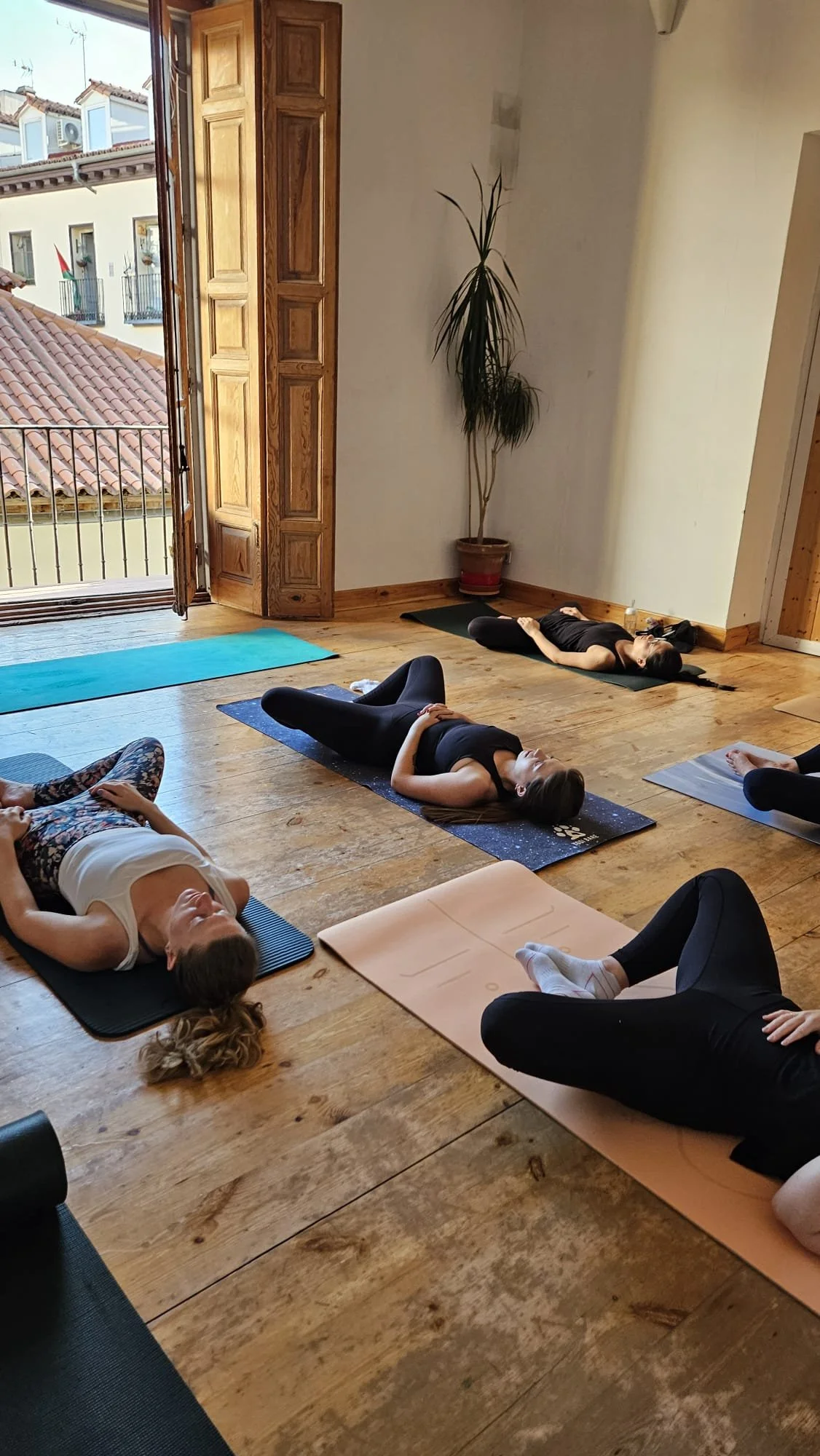
Group practising Yin yoga in a lying butterfly pose in our Madrid class
What is Yin yoga?
Yin is a slower style of yoga where poses are generally held for longer periods of time, often with the support of props and without trying to force the body into a particular shape.
Rather than moving continuously from one pose to the next, you settle into a position and give yourself time to notice what is happening.
That might mean noticing physical sensations, your breath, your thoughts and how you feel in that moment.
The intention isn't to achieve the deepest version of a pose.
It's about finding an appropriate place to be, staying for a while and paying attention.
What is happening physically?
Doing less doesn't mean your body isn't doing anything.
Yin creates a different physical experience from a more active Hatha practice. Rather than repeatedly contracting and moving through the muscles, we spend longer periods in relatively passive positions.
This gives us time to explore sensations in the body and to work with tissues that aren't always the focus of a more dynamic practice.
You may have heard Yin described as a practice that works with the fascia, the network of connective tissue that surrounds and connects muscles, organs and other structures throughout the body.
Fascia has important mechanical and sensory roles, and researchers are increasingly interested in how connective tissue responds to movement, loading and stretching. But it's an oversimplification to say that Yin simply "stretches the fascia" or that all of its effects can be explained by fascia.
What we do know is that longer-held positions provide a different physical stimulus from active movement. Regular stretching and movement can influence things like flexibility and range of motion, although the reasons for those changes are more complex than simply lengthening one particular tissue.
And there can also be something valuable about simply spending time paying attention to physical sensation.
Where do you feel tension?
What changes when you stay for another minute?
Does a different prop or position make the experience more comfortable?
Rather than trying to force the body into a particular shape, Yin gives you time to notice and respond.
And that's another reason why "doing less" doesn't necessarily mean doing nothing.
Yin isn't about stretching further
One of the biggest misconceptions about Yin is that it's simply a way of getting a deeper stretch.
Although Yin poses can create strong physical sensations, the aim isn't to push yourself towards your maximum range of movement.
Instead, we might explore a position until we find an appropriate amount of sensation and then stay there.
That requires a different kind of awareness.
We have to notice the difference between a sensation that feels useful to explore and one that tells us to back off.
You have to make adjustments when your body asks for them.
And you have to resist the temptation to compare your shape with someone else's.
There is no particular pose you need to "achieve".
Doing less isn't always easy
We're generally quite good at doing.
We work, exercise, answer messages, make plans, solve problems and fill our time.
Even when we're resting, we can find ourselves scrolling through our phones or thinking about what we need to do next.
Yin creates a different experience.
You find your position. You settle. And then there is very little else to do.
At first, that can feel wonderful.
And then we might notice our mind becoming busy.
We might think about work, a conversation from earlier, something we need to remember or whether we should move out of the pose yet.
That's all part of this practice.
Not because you need to somehow stop thinking, but because you have the opportunity to notice what your mind does when there isn't something else demanding your attention.
What happens when we stop trying to achieve?
This is one of the things I love about Yin.
We're so used to measuring progress: whether I’m stronger, more flexible, doing it “right”, going further than last time.
Yoga can easily become another place where we try to improve ourselves.
Yin yoga offers an opportunity to practise something different.
What if the point isn't always to get somewhere?
What if, for a while, the practice is actually about paying attention to where you already are?
This connects to something much broader in yoga philosophy: the practice isn't only about what we do with our bodies. It is also about how we relate to our experience.
And doing less can give us more space to notice.
Staying with what is
Longer-held poses can also teach us something about our relationship with discomfort.
Not all discomfort means something is wrong. But neither does discomfort automatically mean we should stay.
Yin asks us to pay attention and make a choice.
Can I stay here comfortably enough to explore the experience?
Do I need to change the position?
Would a prop help?
Am I forcing something because I think I should be able to go further?
That kind of discernment is part of the practice.
And it can be useful in our everyday life, outside of yoga classes.
Why Yin can feel so different
If you're used to a more active Hatha class, Yin will feel different at first.
There is less movement. Fewer transitions. More time in each position.
You might even find yourself wondering whether you're "doing enough".
But that's precisely the point.
Yin isn't trying to give you the same experience as a more active practice.
Sometimes we need movement and energy.
Sometimes we need strength and focus.
And sometimes we need to practise staying. You can read more about how to choose between hatha or yin yoga here.
That's why we include Yin Yoga alongside Slow Hatha in our Wednesday classes in Madrid. The two approaches complement each other: we move, explore and build some warmth, and then have time to slow down and stay.
On the first Wednesday of each month, the full 60-minute class is Yin. On the other Wednesdays, the class combines Slow Hatha & Yin.
If you're new to yoga, you don't need to practise every day to benefit from it, consistency matters more than doing a lot at once. I’ve written more in How Often Should You Practise Yoga as a Beginner.
When you're new to Madrid, too
If you've moved to Madrid from another country, your life may look exciting from the outside while still requiring a lot of adjustment.
You're figuring out where to shop, where to exercise, how to meet people, which neighbourhoods feel like home and how to build a routine that actually feels like yours.
An English-speaking yoga class can become part of that routine.
Not just because you can practise in a language that feels more natural, but because you start seeing the same people each week.
You might arrive knowing nobody and, over time, recognise familiar faces. You might chat before class, grab a coffee afterwards or find yourself meeting people outside the studio.
That's one of the things I love about having a yoga community in Madrid: the practice gives you something that is yours, while the people around it can help a new city feel a little more familiar.
If you're new to Madrid and looking for an English-speaking yoga class, you can read more about finding a yoga community in English in Madrid.
Yin at Atiyasana
Our Wednesday evening classes are designed to give you both movement and space to slow down.
Most Wednesdays, Slow Hatha & Yin combines a steady-paced Hatha practice with longer-held Yin poses.
On the first Wednesday of each month, we spend the full 60 minutes practising Yin.
Classes are in English and are open to all levels. You don't need to have done Yin before, and you certainly don't need to be flexible. If you've never been to a yoga class before, you can also read what to expect at your first yoga class.
You just need to be willing to slow down.
Because sometimes doing less is exactly what we need.