There are lots of good reasons to start practising yoga. Perhaps you want to become more flexible, build strength, improve your balance or move your body after a long day sitting at a desk.
And there's absolutely nothing wrong with any of those reasons. Yoga can be a wonderful way to feel stronger and more comfortable in your body.
But something interesting can happen when you've been practising for a while.
You might notice that you're not reacting to things in quite the same way. Something that would once have frustrated you doesn't bother you as much. You find yourself taking a breath before responding, rather than immediately reacting. Or perhaps you start to recognise when you're stressed or overwhelmed before it gets to the point where you feel completely frazzled and exhausted.
These changes can be subtle. You might not even connect them to your yoga practice at first.
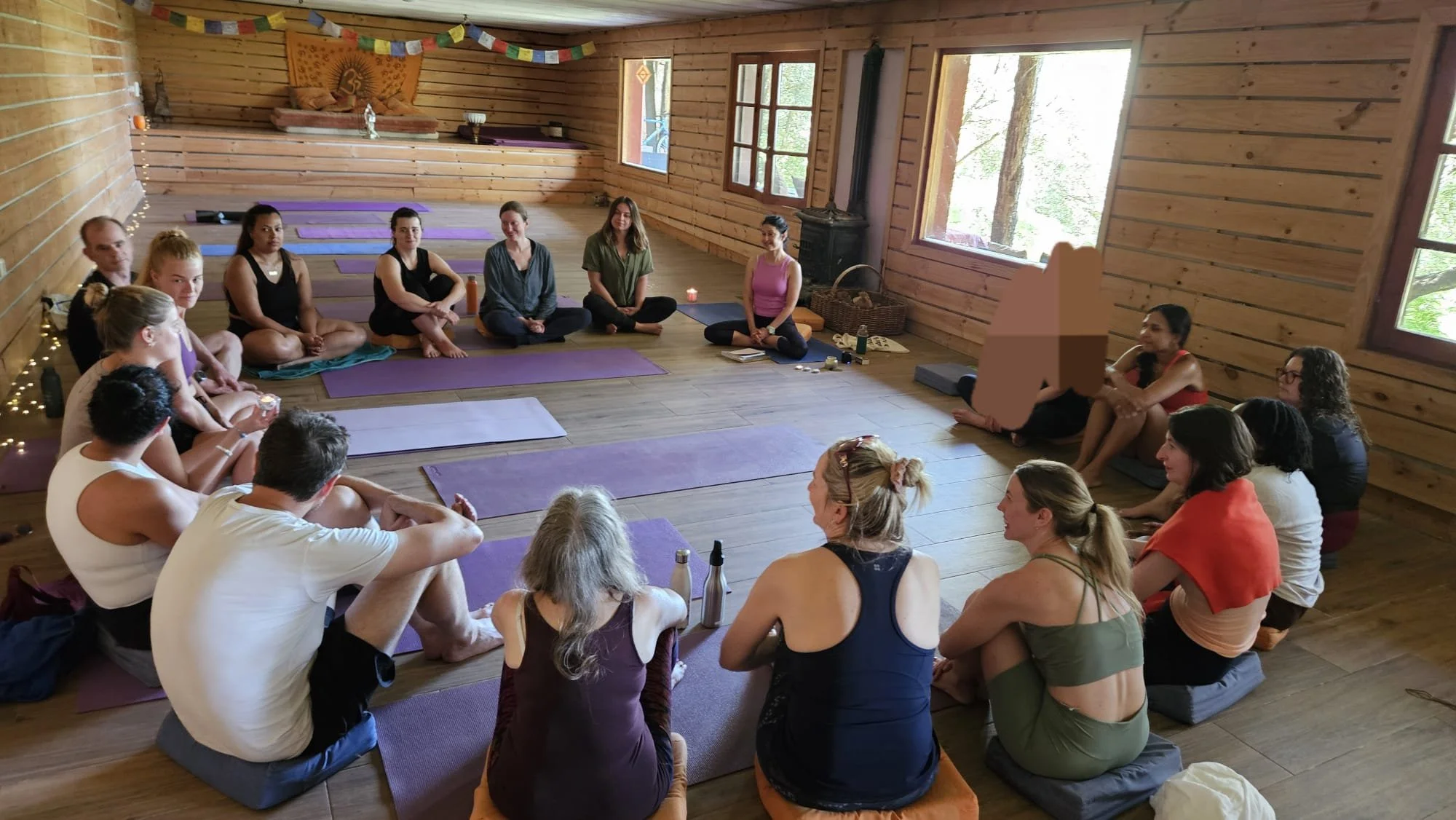
Atiya giving a talk during a yoga retreat
What we're practising beyond the postures
When we practise yoga, we're not only moving our bodies into different shapes. We're also learning to pay attention.
We notice how we're breathing, where we're holding tension and what happens when something feels difficult.
Perhaps you find yourself getting frustrated when you can't balance in tree pose. Maybe you compare yourself to the person next to you, or push a little harder than you need to because you think you ‘should’ be able to do something.
None of these reactions are wrong. They're things we can begin to notice.
And that awareness gives us an opportunity to respond differently.
Maybe you decide to put your foot down in tree pose and try again. Maybe you recognise that you're tired and choose a less demanding variation. Or perhaps you realise that you don't need to prove anything to anyone, including yourself.
These might seem like small moments yet they are part of the practice too.
Learning about ourselves through yoga
One of the things I find most interesting about yoga is how much it can reveal about our habits.
Do we rush through things? Do we get impatient when progress feels slow? Are we comfortable resting, or do we feel we should always be doing something?
Our yoga practice can give us a space to observe these tendencies without necessarily needing to change them immediately.
And sometimes, what we notice in classes starts to become familiar in everyday life.
We might recognise that same impatience when we're stuck in a queue, or notice that we're holding our breath when dealing with a difficult situation at work.
The difference is that we become more aware of what's happening, and a little more able to choose how we respond.
Yoga has always been about more than physical exercise
Although physical postures are often the most visible part of modern yoga, they're only one part of a much broader practice.
In Patanjali's Yoga Sutras, the eight limbs of yoga include ethical principles, physical postures, breath practices, concentration and meditation.
They're concerned not just with what we do with our bodies, but also with how we relate to ourselves, other people and the world around us.
This is one reason I like to include some yoga philosophy in my classes. Not because everyone needs to study ancient texts or know Sanskrit terminology, but because these ideas can help us make sense of what we're experiencing.
Read more about why I include yoga philosophy in my classes.
The changes aren't always obvious
Of course, practising yoga doesn't mean we never feel stressed, lose our patience or have a difficult day.
I certainly don't think the aim is to become someone who is calm all the time.
But with regular practice, we begin to recognise our reactions sooner. We might find it easier to settle after a stressful day, or become more understanding of ourselves when things don't go as planned.
And perhaps one of the biggest changes is that we start to understand ourselves a little better.
We begin to recognise what we need, when to make an effort and when to give ourselves a break.
We can still enjoy becoming stronger, improving our flexibility or working towards a posture we've found challenging. Those things don't disappear.
They're just not the only measure of what we're gaining from practising yoga.
Bringing yoga into everyday life
We don't need to spend hours practising yoga or meditating to experience some of these benefits.
Sometimes it's as simple as noticing our breathing when we're feeling stressed, recognising that we're becoming impatient, or giving ourselves a moment before responding to something difficult.
These are small ways of bringing the awareness we practise in classes into everyday life.
And for me, that's where yoga becomes especially meaningful.
We’re not aiming to be perfect at handling everything that comes our way. Instead we begin to understand ourselves and our reactions a little better.
For me personally, yoga has really helped with anxiety and overthinking. When I first started practising, I noticed a huge difference. Now, regular practice helps me recognise when I'm overthinking and put things into perspective more easily.
You can read more about how yoga can help with stress and overthinking here.
Practising yoga in Madrid
In my yoga classes in English in Madrid, we work on strength, flexibility, balance, movement and we include breathing, awareness and yoga philosophy.
You don't need any previous experience or knowledge of yoga philosophy to join us.
Explore my yoga classes in English in Madrid and find a class that suits you.